Showing posts with label Rolls Royce. Show all posts

Monday, 12 December 2016

Rolls-Royce holds 3rd EngD conference

Rolls-Royce held its third Engineering Doctorate Conference on 21st November at the Learning & Career Development Centre in Derby. This exhibition provided Rolls-Royce sponsored Engineering Doctorate (EngD) researchers to showcase their cutting-edge research, promoting the EngD scheme through innovation.

The Rolls-Royce EngD Network hosted this exhibition, providing a gateway to provide EngD researchers with an opportunity to communicate and collaborate with other EngD researchers across all sectors of Rolls-Royce. The Network was founded in 2012 by EngD researchers Oliver Nowers, Maria Felice and James Pettit, to promote awareness of the EngD scheme and the benefits that it has provided to Rolls-Royce.

Presentations were given by previous and current EngD researchers, ranging from a novel diamond rotary concept for grinding aerospace materials to the In-Situ Patch Repair of Thermal Barrier Coatings, revealing a high-level summary of background knowledge and ongoing research efforts that are being incorporated into their projects.

Invited keynote speakers included Frank Kirkland, Chair of Rolls-Royce Fellows and Chief Designer for Civil Aerospace, who has worked on a range of RR aerospace engines since he joined Rolls-Royce in 1981. Invited speaker Sam Turner, Chief Technical Officer of the AMRC with Boeing, who is responsible for technology strategy, capability growth and support to the AMRC departments and relationship management with major stakeholders. He had delivered high impact projects in manufacturing research and its application towards the industry.

Mark Jefferies, Chief of University Research Liaison presented insight into the effectiveness and strategic development of key academic research partnerships for Rolls-Royce. This includes the company's worldwide network of 31 University of Technology Centres engaging with hundreds of academics and researchers. Also presents the critical impact of collaborative research, developing the fundamental technology, tools and skills required by Rolls-Royce, maintaining scientific excellence.

EngD poster events were held at the Heritage Museum in addition to a variety of DTC stands, exhibiting their research with potential application to Rolls-Royce technologies. Universities including Nottingham, Bristol, Southampton, Surrey, and Birmingham have participated.

This event demonstrates the continued commitment from Rolls-Royce to invest in the next-generation of engineering challenges, and the value of the EngD programme for the transfer of skills and development from academia towards the industry.

(contributed by Lee Pardoe, EngD research engineer at Southampton University)

Monday, 14 December 2015

Rolls-Royce Engineering Doctorate Conference returns to Derby

On 27 November 2015 the Rolls-Royce Engineering Doctorate Network held its annual conference in Derby, building on the success of last year’s inaugural event with record attendance. Delegates from universities and Rolls-Royce plc were brought together, with representatives from across the UK and internationally, to explore how the Engineering Doctorate (EngD) scheme drives the progression of research and technology and why it is vital to the continual success of the company.

Held at the Learning and Career Development Centre in Derby, the conference was attended by 160 current and former EngD researchers, Rolls-Royce employees and university representatives. A comprehensive range of topics were presented, from materials science to systems engineering, demonstrating the far-reaching impact that the EngD scheme has across all aspects of the aerospace and nuclear sectors of the business.

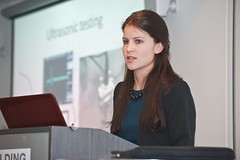
EngD Researcher Jack Palmer presenting on
advanced machining techniques. Photo – Rolls-Royce plc
Work completed under the four-year EngD scheme is of equal academic rigor to more traditional PhD research, however the EngD researchers are typically based within Rolls-Royce for 75% of their time on the scheme to ensure their work is closely aligned to targeted applications within the company. This ensures that the world-leading research of UK universities is translated into novel, but practical solutions - the kind that Rolls-Royce needs to keep its competitive edge.

In the first plenary speech of the day, Prof. Ric Parker, Director of Research and Technology at Rolls-Royce, gave an engaging insight into the importance of the EngD scheme within the current structure of the business. He highlighted the sheer scale of the Rolls-Royce research network, demonstrating how it reaches across the UK and the rest of the world to utilize the best expertise available. This was made evident by the attendance of Rolls-Royce affiliated researchers from the University of Virginia, U.S., and the Brandenburg University of Technology Cottbus, Germany.

An EPSRC view

Neil Bowering (EPSRC) speaking at the Conference.
Photo – Rolls-Royce plc
Neil Bowering, the Associate Director of Business and User Engagement from the Engineering and Physical Sciences Research Council (EPSRC), discussed the strong current and historical links between EPSRC and Rolls-Royce. He promoted the vision of EPSRC: to invest in the next generation of talented scientists, allowing the UK to maintain and capitalise on its position as a leading research nation.

Neil said “EPSRC was really pleased to be part of the conference and more importantly enjoyed the event and the opportunity to network with some clearly very talented and knowledgeable researchers. The range of topics being investigated was great to see and a testament to the value that Rolls Royce places on supporting and engaging with talented individuals on excellent research.”

Technical presentations

Throughout the morning and afternoon sessions of the conference, EngD researchers at different stages of the 4 year doctorate presented on their technical work, with talks ranging from ‘Investigating the Role of Radiation in Corrosion within Simulated Light Water Reactor Conditions’ to ‘High Sensitivity Eddy-Current Arrays’. The conference also provided an excellent opportunity to learn about advancements in the state-of-the-art research and technology through partnerships with Rolls-Royce in the student poster exhibition and Doctoral Training Centre (DTC) exhibition. In total, 12 DTCs and 11 Universities were represented throughout the day, including Nanyang Technological University and the National University of Singapore, who sponsor students in collaboration with Rolls-Royce on the Industrial Postgraduate Placement (IPP) – an analogous qualification to the EngD.

Rolls-Royce EngD researchers
at the conference. Photo – Rolls-Royce plc
“Building on the success of the event last year was a huge achievement. The conference provides an important and unique opportunity for researchers from industry and academia to promote their work and to communicate in the context of the EngD.” said Richard Phillips, who led the organisation of the conference along with fellow EngD researchers Roy Brown, Jack Palmer and Fiona Schulz.

The conference included an exhibition of the state-of-the-art
research conducted by affiliated research centres.
Photo – Rollo Jarvis.
The conference was hosted by the Rolls-Royce EngD Network which aims to increase the collaboration and awareness of EngD researchers within the company. If you would like to know more information please contact Jack Palmer or other members of the network committee (contact details below).

Attendee Kyle Marshall, an EngD Researcher with the IDC in Machining Science, said: ‘The quality of the student conference gave testament to the unique opportunity the EngD program provides, through the interaction with both industry and academia, to solve real world engineering challenges through post graduate research.’ Kyle Marshall, EngD Researcher with the IDC in Machining Science.

Rolls-Royce EngD Network Committee:

Thursday, 28 May 2015

Being an EngD research engineer: Matt Bees

(Matt Bees is an EngD researcher with the Institute of Structural Materials (ISM) at Swansea University, and has been based at Rolls-Royce plc in Derby since October 2011, working with the Critical Parts & Lifing (CPL) group on a project entitled “The Effect of Loading Proportionality on Fatigue Life.”)

I am now in the final months of my EngD programme (almost wondering where all the time has gone!), and in my time at Rolls-Royce plc, I have learnt many techniques and skills that have helped me become a better engineer and manage my own project.

My research


I am assessing the multi-axial fatigue and loading response of turbine discs for the current civil Trent engine fleet. My project has involved a lot of literature research (both public and Rolls-Royce domain), computational modelling, finite element (FE) analysis, multi-axial (tension-torsion) testing of small tubular specimens at Swansea University, and documentation for internal reports.

Most of my first year was spent conducting research and carrying out the necessary analysis of turbine discs in order to build a solid foundation for the remainder of my EngD programme. Frequent meetings with my industrial supervisor were key to my development and understanding, especially in the opening months – as my undergraduate degree was motorsport engineering. Socialising with other EngD students and learning from their past experiences was also invaluable.

As I unearthed more facts and issues regarding to multi-axial fatigue, I was fortunate to work with people from the Mechanical Methods team, helping to run some tension-torsion tests on a nickel super-alloy, were I took charge of analysing the data. This yielded some interesting results and my supervisors encouraged me to attend and present at the 10th International Conference on Multi-axial Fatigue & Fracture, in Kyoto in June 2013.

The conference gave me the opportunity
 to visit Kyoto and Tokyo.
Following this conference, my paper was chosen for a special edition of the International Journal of Fatigue published in October 2014. This was a great boost for my thesis, while the conference experience boosted my confidence in delivering technical presentations in Rolls Royce.

In my third and fourth years, my EngD has focussed on computational modelling, laboratory testing and documenting various reports for both academic and industrial purposes. This is when the importance of the project really hit me: my fatigue model research underlined the complexities of multi-axial fatigue and loading, and the resulting impact on fatigue life (explained in the literature but not previously supported by modelling). I am now using current and new methods to change this, whilst being supported by my supervisors and members from the Mechanical Methods group – it’s clearly an important topic for the company!

Mentoring, advising, and inspiring at Rolls Royce


Given my EngD experiences, I felt it was important to share these with other students. I now have monthly mentor meetings with a third year EngD student from Cambridge University, helping him see the 'bigger EngD picture' and make the most of his time and expertise to complete his project. I would recommend more students do likewise for the next intake of students.

Since August 2014, I have been part of the EngD Network team at Rolls-Royce. This provides a platform for communication and collaboration between EngD students across the company's nuclear and aerospace sectors. It also helps raise the profile of the EngD qualification within Rolls-Royce and the wider engineering community, and organises events to allow wider dissemination of EngD research.

We held our first EngD conference in November 2014, with current and past students presenting their work and findings, and showing its relevance to the company’s technology. The conference was a huge success with over 140 attendees, with talks from Henner Wapenhans, head of technology strategy at Rolls-Royce, and Martine Gagne, head of the Rolls-Royce Strategic Research Centre (SRC), and I presented an overview of my EngD programme to date.

EngD tips


With my EngD finish date approaching, I’m glad I took the advice of other EngD students and started my thesis as soon as I could. I might only be half-way through, but starting early is definitely better than waiting until most of the work is finished with a month or so to go! What else would I tell EngD research engineers?

  • Start your literature research early so that you learn about your project. It's never too early to start thinking about your thesis, and a good literature chapter provides a solid foundation for your project.
  • Spend as much time within your industrial sponsor’s department as possible; you learn more here as you progress through your EngD
  • Embed yourself within the university and workplace; research can be lonely so mix in with other students and employees.
  • It's important to relax as much as you can, so you can feel refreshed and energetic over your study period.
  • Don’t get off on the wrong foot: build a good relationship with your supervisors - you will be working together for a long time
  • Attend / present at a relevant conference. It’s a great experience, potentially boosting your thesis and viva presentation.
  • Finally: enjoy your research project - you’ll end up being an expert in your field when you are done!

(Matt Bees' research has been funded by the Engineering and Physical Sciences Research Council (EPSRC), Innovate UK (formerly the Technology Strategy Board), Rolls-Royce plc and Swansea University, and he acknowledges the invaluable financial support provided by all parties.)

Monday, 19 January 2015

YES to engineering entrepreneurship!

Engineering YES (Young Entrepreneurs Scheme) is a simple and direct way for universities to educate researchers all about innovation commercialisation. Fundamentally, it is a team-based training event. YES take a “hot house” approach, exposing participants to a fast-paced, experiential environment. All training is delivered by business and industry specialists (covering areas including Intellectual Property, finance, marketing, routes to market, venture capital, etc).

Each team brings a “future possible” idea for an engineering-related technology or service which could be taken to market. This is normally loosely based on the real research of one of the team members. They apply their learning to this idea as they develop a business plan to bring it to market. Their plan is presented orally to a panel of industry judges on the third day of the event.

YES 2014 involved 125 researchers grouped into 25 researcher teams from 12 different UK Universities, and around 50 speakers, mentors and judges from business and industry (eg: Rolls-Royce, E.ON), patent attorneys, venture capitalists and engineering entrepreneurs.

Applications for the 2015 competition need to be submitted by 13 March, with regional heats taking place during April, May and June, ahead of a grand final in Birmingham on 17 June.

Funding

Researchers need to be funded onto the programme by their home universities. Historically, this has led to the event being dominated by researchers from larger red-brick universities, but even central funding streams at these institutions are running out, so the event is looking for more industry support. According to YES coordinator Dr Jo Gilman:

"We work without any central funding and fund our programme using a “pay by participant” model – so each university that sends researchers to us pay fees for each person they send. The average spend for a team of researchers is around £4,000."

Friday, 28 February 2014

Materials researchers highlighting EngD opportunities

Two EngD research engineers have recently written website articles about their activities.

The EngD: Dr Who?

Richard Howard, studying in the Non-Destructive Evaluation industrial doctorate centre and based at London's Imperial College, wrote a feature, The EngD: Dr Who? for the college's online publication, Felix. He is clearly enthusiastic about both the programme itself and the immediate and long-term benefits it offers. Here's a few soundbites....

Merging the academic with the practical, it is a fulfilling way to apply the piles of knowledge that you have accumulated over your undergraduate years to real world problems. ...
... the doctoral students become experts in a key industry that will be relevant for many years to come. The remit of the doctorate is also to train future business leaders in these areas as well as furnishing them with technical expertise. For example, the UK’s renewed interest in nuclear power underscores the need for a new generation of nuclear engineers and since there is a dearth in nuclear experts (of all types) the current cohort of EngD nuclear engineers will be the ones running the industry in the future.
Importantly, the scheme is NOT just for engineers, scientists are actively encouraged...
If you are looking for a career in a particular industry, or at particular company, then an EngD can easily be far more than a foot in the door; more like a whole leg! You’ll work closely with your sponsor’s researchers and will make a raft of contacts, setting you up nicely.
Finally, when it comes to pay there should be no beating around the bush; an EngD candidate gets one of the highest academic postgraduate stipends available... This is the way it should be, treating you like a graduate research engineer with a pay scale to match.

Maria's Diary

Maria Felice, is also an EngD research engineer with the Non-Destructive Evaluation industrial doctorate centre, but is supervised from its University of Bristol site. She is based at Rolls Royce plc and was a finalist in the 2013 AEngD Research Writer of the Year competition. For the Institution of Engineering and Technology (IET) she wrote a diary entry highlighting her recent activities. She clearly valued the AEngD conference, and is worried about recent changes to EngD funding:
There was a meeting for EngD students - or ‘research engineers’ - at the conference, which was a great opportunity to talk to students from other EngD centres. At each university there are not many EngD students so we tend to become part of the PhD community, but there are actually quite a lot of differences between the two programmes e.g. EngD students tend to be based in industry.
...
A few days prior to the conference, it had been announced that funding for EngDs will be drastically reduced. This was a big shock since all stakeholders seem to be in agreement that the EngD is a highly successful scheme that is beneficial to the UK industry. It was not a surprise, therefore, that this was the main topic of conversation at the conference. However, it was still a fantastic celebration of the EngD scheme and the funding decision is going to be challenged.