Showing posts with label Southampton. Show all posts

Monday, 12 December 2016

Rolls-Royce holds 3rd EngD conference

Rolls-Royce held its third Engineering Doctorate Conference on 21st November at the Learning & Career Development Centre in Derby. This exhibition provided Rolls-Royce sponsored Engineering Doctorate (EngD) researchers to showcase their cutting-edge research, promoting the EngD scheme through innovation.

The Rolls-Royce EngD Network hosted this exhibition, providing a gateway to provide EngD researchers with an opportunity to communicate and collaborate with other EngD researchers across all sectors of Rolls-Royce. The Network was founded in 2012 by EngD researchers Oliver Nowers, Maria Felice and James Pettit, to promote awareness of the EngD scheme and the benefits that it has provided to Rolls-Royce.

Presentations were given by previous and current EngD researchers, ranging from a novel diamond rotary concept for grinding aerospace materials to the In-Situ Patch Repair of Thermal Barrier Coatings, revealing a high-level summary of background knowledge and ongoing research efforts that are being incorporated into their projects.

Invited keynote speakers included Frank Kirkland, Chair of Rolls-Royce Fellows and Chief Designer for Civil Aerospace, who has worked on a range of RR aerospace engines since he joined Rolls-Royce in 1981. Invited speaker Sam Turner, Chief Technical Officer of the AMRC with Boeing, who is responsible for technology strategy, capability growth and support to the AMRC departments and relationship management with major stakeholders. He had delivered high impact projects in manufacturing research and its application towards the industry.

Mark Jefferies, Chief of University Research Liaison presented insight into the effectiveness and strategic development of key academic research partnerships for Rolls-Royce. This includes the company's worldwide network of 31 University of Technology Centres engaging with hundreds of academics and researchers. Also presents the critical impact of collaborative research, developing the fundamental technology, tools and skills required by Rolls-Royce, maintaining scientific excellence.

EngD poster events were held at the Heritage Museum in addition to a variety of DTC stands, exhibiting their research with potential application to Rolls-Royce technologies. Universities including Nottingham, Bristol, Southampton, Surrey, and Birmingham have participated.

This event demonstrates the continued commitment from Rolls-Royce to invest in the next-generation of engineering challenges, and the value of the EngD programme for the transfer of skills and development from academia towards the industry.

(contributed by Lee Pardoe, EngD research engineer at Southampton University)

Tuesday, 22 March 2016

EngD and leadership

Engineering leadership is not just about applying technical knowledge and experience; for some, it's also about learning about themselves.

On Tuesday 1st March 2016, Oliver Robinson, an EngD researcher at the University of Southampton attended an audience with HRH The Duke of Edinburgh at St James’ Palace to receive his Gold Duke of Edinburgh's certificate.

Hosted in the state apartments, where centuries of significant royal events have occurred, Oliver spoke with His Royal Highness about the voluntary role he undertook as the President of the Duke of Edinburgh’s Award Society at the University.

Recognised by employers and institutions across the UK, the award sees young people below the age of 25 pursue a number of ‘sections’, individually tailored to provide a unique programme of self-development. Any young person below the age of 25 is eligible to enrol on the award, which progresses in stages from Bronze and Silver to Gold. Since it is the highest award offered by the DofE scheme, achievement of the Gold award is recognised by the Duke himself at the Palace.

All five sections must be satisfied in order to achieve the award, with the service, physical and skill sections taking around a year to complete.

Besides holding a voluntary role in a society at the university, Oliver learned to drive in order to satisfy the skill element and developed his rock-climbing ability in the physical section. He then spent a week of his residential activity in Dorset assisting with delivering a Scout summer camp for 14-18 year olds, before undertaking two four-day expeditions on concurrent summers: the practice in Dartmoor and the assessment in the Brecon Beacons.

Thursday, 5 February 2015

Southampton EngD researcher wins sustainability award

Southampton University EngD researcher Oliver Robinson has won the university's 2014 Sustainability Action Award. According to the scheme's blog, Oliver says:

“Being recognised in this way shows how the university appreciates the work done by its students to improve the local community and beyond and that it takes its responsibility as a champion of sustainability seriously. I am proud to have been a part of the expedition and thankful for the acknowledgement given to me by the University.”


Oliver volunteered with the Hampshire Scouts Expeditions (HSX), a local county Scout Group dedicated to the training and development of young scouts.

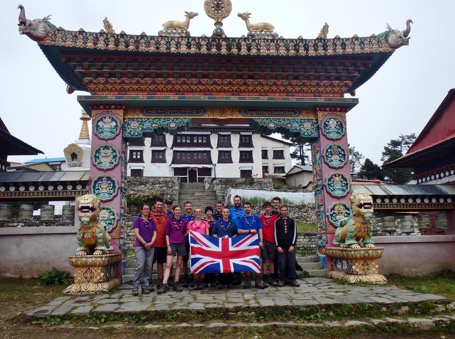
Having benefited from being a scout himself, Oliver was a leader of a six-week expedition to Nepal, leading 11 scouts to the Everest Region of the Himalayas. This was a unique opportunity for 14-18 year olds to develop as future leaders, honing their navigation, planning and teamwork skills through physical activities such as rock-climbing, mountaineering and abseiling. An integral part of the exhibition was a two-week community project, painting and maintaining the school buildings and classrooms at Khumjung Secondary School (for Sherpa children) with the Himalayan Trust, a charity founded by Sir Edmund Hillary. The scouts also engaging with environmental issues, such as the fading Khumbu glacier and expanding Himalayan glacial lakes, and social matters first hand.

Oliver continues to be part of HSX to develop and inspire future Hampshire Scouts.

Monday, 9 June 2014

Southampton EngD's 'Three minute thesis'

Three Minute Thesis is a research communication competition developed by the University of Queensland which challenges research higher degree students to present a compelling oration on their thesis and its significance in just three minutes in language appropriate to a non-specialist audience.

Daniel Lurcock, an EngD research student, entered the University of Southampton's Faculty of Engineering and the Environment heats and reached the Faculty final, where he narrowly missed going on to represent Engineering and the Environment at the University final.


The Three Minute Thesis is a good example of how academia can be made more accessible to non-academic audiences. We've found other examples in the UK including the PubhD ("InngD, maybe"? - post) and the Science Showoff (post).

Wednesday, 14 May 2014

EngD team racing underwater

A team of EngD students from the University of Southampton are competing in the 2nd biennial European International Submarine Races (eISR - see Subrace.eu) at QinetiQ's Ocean Basin in Gosport, UK this summer. The overall objective of the eISR is to encourage innovative design in submarine engineering.

The teams have to design and build a human powered submarine ready to race in the competition in July. The submarines will race several times and will be judged on aspects of the design as well as speed.

Keep an eye on this page for updates of the team's progress in the run up to the competition.

Tuesday, 30 April 2013

To RE or not to RE?

An email from Dr Andrea Haworth, Centre Manager at the Industrial Doctorate Centre in Machining Science (University of Sheffield) has got people talking about "how IDCs refer to EngD students/Research Engineers (and perhaps more importantly how EngDs refer to themselves)."
We appreciate that there is good reason and a strong steer to call them “Research Engineers”, but many people have a job title “Research Engineer” and aren’t EngD candidates. 
I really do try, but if I refer to  “Research Engineers”, most people don’t know that I’m talking about, or might, at best, assume that I mean someone who has gained the EngD qualification.
I tend to alternate between “EngD student” (which I don’t like but which is sort of understood) or ”EngD Research Engineer”, or as a complete get out, just “EngD”.  On business cards the students are referred to Research Engineer/ EngD Candidate or similar.
I was wondering whether “Postgraduate Research Engineer” might do (cf “Postgraduate Research Student”).  Or have I just invented something else to confuse? How do other IDCs handle this? 

Responses

  • Sally Hawthorne at Southampton's IDC on transport and the environment said: "the students themselves wish to be known as ’EngD researchers’ and that’s what’s on their door signs and on their business cards."
  • From the Manufacturing Technology centre at Nottingham, David Shipley said: "We tend to call ours Research Engineers or EngD Research Engineers. They seem to appreciate not being referred to as students externally. ... Ours tend to have Research Engineers on their business cards."
  • Steven Yeomans (Loughborough's CICE) also said: "I use Research Engineer when dealing with anyone other than internal university systems, where I then use the term EngD student."
  • David Stanley (Nuclear Engineering IDC) adopts the same approach: "externally we try to use 'Research Engineers' as much as possible and we also get them to put this on business cards. It adds a bit of kudos at conferences etc."
  • Justine Easten from STREAM's Newcastle location, says: "I use EngD Research Engineers, and our researchers have business cards to say this, followed by their industrial sponsors name...."
The AEngD has tended to use 'Research Engineer' too, but what do you think? If you are engaged in an EngD programme, what title do you prefer?