Thursday, 28 May 2015

Being an EngD research engineer: Matt Bees

(Matt Bees is an EngD researcher with the Institute of Structural Materials (ISM) at Swansea University, and has been based at Rolls-Royce plc in Derby since October 2011, working with the Critical Parts & Lifing (CPL) group on a project entitled “The Effect of Loading Proportionality on Fatigue Life.”)

I am now in the final months of my EngD programme (almost wondering where all the time has gone!), and in my time at Rolls-Royce plc, I have learnt many techniques and skills that have helped me become a better engineer and manage my own project.

My research


I am assessing the multi-axial fatigue and loading response of turbine discs for the current civil Trent engine fleet. My project has involved a lot of literature research (both public and Rolls-Royce domain), computational modelling, finite element (FE) analysis, multi-axial (tension-torsion) testing of small tubular specimens at Swansea University, and documentation for internal reports.

Most of my first year was spent conducting research and carrying out the necessary analysis of turbine discs in order to build a solid foundation for the remainder of my EngD programme. Frequent meetings with my industrial supervisor were key to my development and understanding, especially in the opening months – as my undergraduate degree was motorsport engineering. Socialising with other EngD students and learning from their past experiences was also invaluable.

As I unearthed more facts and issues regarding to multi-axial fatigue, I was fortunate to work with people from the Mechanical Methods team, helping to run some tension-torsion tests on a nickel super-alloy, were I took charge of analysing the data. This yielded some interesting results and my supervisors encouraged me to attend and present at the 10th International Conference on Multi-axial Fatigue & Fracture, in Kyoto in June 2013.

The conference gave me the opportunity
 to visit Kyoto and Tokyo.
Following this conference, my paper was chosen for a special edition of the International Journal of Fatigue published in October 2014. This was a great boost for my thesis, while the conference experience boosted my confidence in delivering technical presentations in Rolls Royce.

In my third and fourth years, my EngD has focussed on computational modelling, laboratory testing and documenting various reports for both academic and industrial purposes. This is when the importance of the project really hit me: my fatigue model research underlined the complexities of multi-axial fatigue and loading, and the resulting impact on fatigue life (explained in the literature but not previously supported by modelling). I am now using current and new methods to change this, whilst being supported by my supervisors and members from the Mechanical Methods group – it’s clearly an important topic for the company!

Mentoring, advising, and inspiring at Rolls Royce


Given my EngD experiences, I felt it was important to share these with other students. I now have monthly mentor meetings with a third year EngD student from Cambridge University, helping him see the 'bigger EngD picture' and make the most of his time and expertise to complete his project. I would recommend more students do likewise for the next intake of students.

Since August 2014, I have been part of the EngD Network team at Rolls-Royce. This provides a platform for communication and collaboration between EngD students across the company's nuclear and aerospace sectors. It also helps raise the profile of the EngD qualification within Rolls-Royce and the wider engineering community, and organises events to allow wider dissemination of EngD research.

We held our first EngD conference in November 2014, with current and past students presenting their work and findings, and showing its relevance to the company’s technology. The conference was a huge success with over 140 attendees, with talks from Henner Wapenhans, head of technology strategy at Rolls-Royce, and Martine Gagne, head of the Rolls-Royce Strategic Research Centre (SRC), and I presented an overview of my EngD programme to date.

EngD tips


With my EngD finish date approaching, I’m glad I took the advice of other EngD students and started my thesis as soon as I could. I might only be half-way through, but starting early is definitely better than waiting until most of the work is finished with a month or so to go! What else would I tell EngD research engineers?

  • Start your literature research early so that you learn about your project. It's never too early to start thinking about your thesis, and a good literature chapter provides a solid foundation for your project.
  • Spend as much time within your industrial sponsor’s department as possible; you learn more here as you progress through your EngD
  • Embed yourself within the university and workplace; research can be lonely so mix in with other students and employees.
  • It's important to relax as much as you can, so you can feel refreshed and energetic over your study period.
  • Don’t get off on the wrong foot: build a good relationship with your supervisors - you will be working together for a long time
  • Attend / present at a relevant conference. It’s a great experience, potentially boosting your thesis and viva presentation.
  • Finally: enjoy your research project - you’ll end up being an expert in your field when you are done!

(Matt Bees' research has been funded by the Engineering and Physical Sciences Research Council (EPSRC), Innovate UK (formerly the Technology Strategy Board), Rolls-Royce plc and Swansea University, and he acknowledges the invaluable financial support provided by all parties.)

Friday, 27 March 2015

Advanced manufacturing: could your company sponsor Aminu's EngD?

Aminu Owonikoko has a place on the engineering doctorate (EngD) programme in Advanced Manufacturing at the University of Strathclyde, but is looking for a sponsor interested in addressing manufacturing industry challenges such as excessive variation in product purity and quality, rework and re-manufacturing.  He is particularly keen to explore how an institution such as the University of Strathclyde could transfer its knowledge to developing countries.

Aminu’s sponsor will benefit from him working with the University of Strathclyde's Advanced Forming Research Centre (AFRC) and the Department of Design, Manufacture and Engineering Management (DMEM) under the supervision of Professor Jonathan Corney.  Aminu also has more than five years of practical experience of applying a range of technologies (such as powder mechanics, tribology/friction properties, biomass handling, post harvest handling/food engineering, technology management) that he thinks have the potential to bring massive benefits to a sponsor looking to grow rapidly.

At the moment, Aminu is a process consultant/consulting engineer at Muniowo Agro Nigeria Ltd (MAN) where he is:

  • Reviewing, revising and realigning manufacturing processes
  • Turning data into critical actions that focus on process control and capability
  • Using data to empower decision makers trying implementing change
  • Geometric reasoning (structural behaviour and integrity) of machine design and construction for clients to gain a competitive edge

He was previously a research project engineer at the Wolfson Centre for Bulk Solids Handling Technology at the UK's University of Greenwich. This exposure to bulk solids handling technology has inspired his research interests because of its potential to enhance reliable flow (movement) in manufacturing processes. Aminu became interested in:

  • Design based on quantified material property values such has particle size and shape distribution, bulk density, wall friction properties, moisture content evaluation. 
  • Design that considers access for retrofit or modification.
  • Design that considers the capital and operational costs of plant
  • Developing a close understanding between user and manufacturer 
  • Minimising reworking/remanufacturing

Aminu’s EngD research project will inevitably adapt to the specific challenges of his eventual sponsor and could pursue the development of profitable novel products, novel materials and novel services. In addition, the research project will also pursue the expansion of in-house professional knowledge, expertise and experience for the partner’s company. Aminu can be reached via email for further information about the terms of the arrangement with the University of Strathclyde including its costs.

Thursday, 5 February 2015

Southampton EngD researcher wins sustainability award

Southampton University EngD researcher Oliver Robinson has won the university's 2014 Sustainability Action Award. According to the scheme's blog, Oliver says:

“Being recognised in this way shows how the university appreciates the work done by its students to improve the local community and beyond and that it takes its responsibility as a champion of sustainability seriously. I am proud to have been a part of the expedition and thankful for the acknowledgement given to me by the University.”


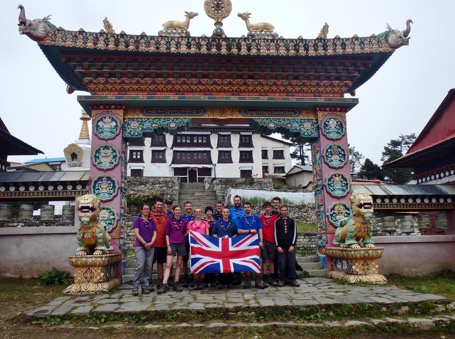
Oliver volunteered with the Hampshire Scouts Expeditions (HSX), a local county Scout Group dedicated to the training and development of young scouts.

Having benefited from being a scout himself, Oliver was a leader of a six-week expedition to Nepal, leading 11 scouts to the Everest Region of the Himalayas. This was a unique opportunity for 14-18 year olds to develop as future leaders, honing their navigation, planning and teamwork skills through physical activities such as rock-climbing, mountaineering and abseiling. An integral part of the exhibition was a two-week community project, painting and maintaining the school buildings and classrooms at Khumjung Secondary School (for Sherpa children) with the Himalayan Trust, a charity founded by Sir Edmund Hillary. The scouts also engaging with environmental issues, such as the fading Khumbu glacier and expanding Himalayan glacial lakes, and social matters first hand.

Oliver continues to be part of HSX to develop and inspire future Hampshire Scouts.

Monday, 19 January 2015

YES to engineering entrepreneurship!

Engineering YES (Young Entrepreneurs Scheme) is a simple and direct way for universities to educate researchers all about innovation commercialisation. Fundamentally, it is a team-based training event. YES take a “hot house” approach, exposing participants to a fast-paced, experiential environment. All training is delivered by business and industry specialists (covering areas including Intellectual Property, finance, marketing, routes to market, venture capital, etc).

Each team brings a “future possible” idea for an engineering-related technology or service which could be taken to market. This is normally loosely based on the real research of one of the team members. They apply their learning to this idea as they develop a business plan to bring it to market. Their plan is presented orally to a panel of industry judges on the third day of the event.

YES 2014 involved 125 researchers grouped into 25 researcher teams from 12 different UK Universities, and around 50 speakers, mentors and judges from business and industry (eg: Rolls-Royce, E.ON), patent attorneys, venture capitalists and engineering entrepreneurs.

Applications for the 2015 competition need to be submitted by 13 March, with regional heats taking place during April, May and June, ahead of a grand final in Birmingham on 17 June.

Funding

Researchers need to be funded onto the programme by their home universities. Historically, this has led to the event being dominated by researchers from larger red-brick universities, but even central funding streams at these institutions are running out, so the event is looking for more industry support. According to YES coordinator Dr Jo Gilman:

"We work without any central funding and fund our programme using a “pay by participant” model – so each university that sends researchers to us pay fees for each person they send. The average spend for a team of researchers is around £4,000."

Research to Industry, September 2015

IMAPS UK
The AEngD has received details of an event promoting industry-academia collaboration. The third Research to Industry day, organised by the UK chapter of the International Microelectronics Assembly and Packaging Society (IMAPS UK), and supported by the IEEE, is taking place at the University of Sheffield on 3 September 2015.

The organisers are hoping for EngD contributions: "EngDs are an excellent initiative to promote such collaborations, and I am looking for some case studies by your members (large and small companies) or an overview of the funding opportunities to foster these relationships," says Dr Anne Vanhoestenberghe (email Anne if you would like further details).

This event, previously attracting over 100 delegates, allows an industrial audience to meet and network with researchers active in the field of microelectronics assembly and packaging. This year's event will include keynotes from the different UK funding bodies (innovate UK and research councils) to explain the different funding options available to the industry, and case studies illustrating the benefits of those schemes to the industrial partner.

Friday, 19 December 2014

A professional doctorate ... but what comes next?

The University of Reading's Graduate School Bulletin (November 2014) featured an interview with Dr Marek Kubik, one of the first graduates from the university's Technologies for Sustainable Built Environments (TSBE) Centre.

A PROFESSIONAL DOCTORATE... but what comes next?

Marek Kubik graduated from the University this summer with an Engineering Doctorate (EngD), from the Technologies for Sustainable Built Environments (TSBE) Centre. 

The TSBE is an industrial Doctoral Training Centre for construction technology, climate and business enterprise research and was established in 2009 with a £6 million grant from the Engineering and Physical Sciences Research Council (EPSRC). Marek followed a four year programme instead of the traditional three year PhD; which included an industry based research project and University taught modules relevant to the project. He was sponsored by AES, a global power company, supported by two academic supervisors and spent a significant amount of time based in industry.

What have you been doing since you graduated?

I took up an advisory position in AES, the company I completed my doctorate with, reporting directly to the Vice President for UK & Ireland. I have responsibility for mapping a route to market for energy storage, something that follows neatly on from my research.

Recently, I successfully led a bid through the first round of Innovate UK funding to support a $6.6m 10MW battery storage project in Northern Ireland (the largest of its kind in Europe). I am also organising a high profile energy storage seminar hosted by the All Party Group at Stormont, Northern Ireland’s Parliament.

Was there anything you did at Reading that you feel has helped you in your new position?

The supportive attitude of the TSBE Centre to pursue career development opportunities, such as my secondment in UK Parliament, teaching STEM (Science, Technology, Engineering and Mathematics) in local schools and Henley Business School mentoring was very valuable. The Graduate School was a useful entity, both in terms of facilities and in networking outside my immediate research group.

Why did you select Reading?

I chose to undertake an EngD at Reading as I wanted a project with strong links to industry and that focused on an immediate industry challenge in the field of sustainability. Working for both the University and my industry sponsor has allowed me to gain invaluable experience, which I believe is the single most important factor in gaining employment post completion.

What was your biggest challenge during your studies?

The biggest challenge was managing the divergent expectations of academia and industry, and keeping both sides happy with the scope and nature of my research. The EngD programme requires delivery on both fronts; the full academic rigor and contribution to knowledge of a PhD, but with added industrial impact and relevance.

Knowing what you know now, what advice would you give a new 1st year doctoral researcher?

My first piece of advice is to publish early. Publishing international conference papers and journal papers helps hone your writing ability and gives you material that can be readily dropped into your thesis. Second, plan ahead. Your time shoots by and you need to factor in writing-up time. I began dedicating a couple of days a month to start writing up 18 months ahead of submission. Finally, enjoy it. It is unlikely you will ever again get the opportunity to have as much flexibility to work in an area and to really think about how to solve the challenges your field faces.

And finally, where do you want to be in 5 years?

I would like to be in a position where I can look back and be proud of delivering the change urgently needed in the energy sector. I want to see ‘us’ on a trajectory of avoiding catastrophic climate change and relieve energy poverty where it exists.

Wednesday, 29 October 2014

EngD graduate leads Belfast Energy Storage event


Marek Kubik,the AEngD's alumni rep, now at AES in Northern Ireland (who sponsored his EngD research at the TSBE centre at University of Reading; Marek is also featured in this week's New Scientist, which mistakenly describes him as a PhD - shame) is co-organising a seminar on energy storage at Stormont in Belfast on 10 November 2014.

The seminar for the Northern Ireland Assembly All-Party Group on Science and Technology, in association with AES, the Energy Institute and Pinsent Masons, features two meetings in the Senate Chamber, Parliament Buildings, Stormont, Belfast, on Monday 10th November 2014 on the subject of Energy Storage.

The first, an Industry session, will take place from 3.00pm to 5.00pm, and the second, a Seminar, from 6.00pm to 8.00pm, will be joined by Arlene Foster MLA, Minister of Enterprise, Trade and Investment.

The theme will be: ‘How can energy storage help reduce energy costs, improve security of supply and meet decarbonisation goals?’’ (more details available via the AEngD website news page)